Player’s Choice Godfest used to be the most anticipated Godfest in Puzzle and Dragons. However, with the transition to six-star supremacy, it has left the player base with almost no choice but to vote them in. GungHo does not release rolling data, but it is my understanding that there is not a fixed percentage allocated to PCGF and instead it is the sum of the voted cards.
Hypothetically speaking, if six-stars have a 0.5% chance of being rolled and pantheon gods/five-stars have a 2% chance, we would have a (0.5*11) + (2*14) = 33.5% of rolling a PCGF featured card. Thus, the chances for Gala/troll golds/silvers increases with every voted six-star.
I go into greater detail for Player’s Choice Godfest in my previous article HERE and is worth taking a look at for a breakdown of each voted card.
Player’s Choice Godfest December 2016
1-5
6-10
11-15
16-20
21-25
Rolling videos
All of these rolls were done on my Twitch Stream to add a greater sense of excitement. Unfortunately, the rolls were far less than exciting as only 1 out of 39 rolls was a six-star GFE (Dantalion on the account that only collects stones).
The rates are quite distressing overall, but at least I got to spend some quality time with MOMtastic.
MOMtastic’s 11 rolls
—
26 rolls across 4 accounts
Conclusion
Player’s Choice is no longer the amazing Godfest it used to be due to heavy reliance on six-stars and their distressingly low roll rates. We can only hope that GungHo begins to bring Pantheon and five-stars on a more comparable power level. I am not saying it has to be equal, but the size of the gap we have today.
There has been plenty of hype and excitement with the Final Fantasy Collab returning to North America; however, players should also be excited about the introduction of a pure Fixed Team Challenge. This challenge provides players with 5 unique and powerful teams to tackle various descends. All of the teams come hypermaxed (+297 and max skill) so we have the opportunity to play and enjoy compositions we would normally not be able to create. This is also a fantastic opportunity for newer/lower rank accounts
I have compiled all of my clears across my two accounts in solo mode to showcase how these teams play and the general strategies used to overcome the various hurdles presented in the dungeons.
Hel vs Deus ex Machina
It was nice how they gave us a nearly 100% farmable team. How do I feel about the poison meta? Hel no.
DQXQ vs Hephaestus Descended
A strange hybrid of water and light subs. I tended to focus on light matches at the beginning and transition over to water rows for the boss
Acala vs Seraphis Descended
It was strange playing a colour cross leader. It was also amusing to see an Odin Dragon and his ridiculous autoheal awakenings. If you are playing this in coop, you can tank the Limit Break enrage hit from the boss and simply go for the one shot on the first turn.
Neptune Dragon vs Zeus & Hera Descended
It is somewhat sad how dated Neptune Dragon has become with powercreep as his multiplier is so low considering how many orbs you have to chain together. Hopefully his future evolution will grant him some relevance.
Tsubaki vs Agni Descended
Probably the only time you will ever see a hypermax Sphinx but it was valuable for executing the Tan on the first floor.
Conclusion
The fixed challenges gives players the opportunity to play leaders that would otherwise be unobtainable along with enjoying a fully invested team. I hope GungHo continues to provide more fixed team challenges as it is a lot of fun to experiment with new playstyles as well as granting lower rank players the opportunity to clear variuos dungeons.
Skill Delay Resist Tamadras (SDR) are now invading Special Descend Rush (SDR), from the coin dungeons, which makes for confusing abbreviations and a wonderful opportunity to acquire the strongest Latent Tamadra. Special Descend Rush features 6 Rogue Descend Bosses along with the leveling up mechanic to further hinder your progress. However, SDR has very predictable mechanics and is able to be cleared with a Glass Cannon team as there are no lethal preemptives. Many players are using Awoken Liu Bei to mindlessly farm, but not everyone is fortunate enough to have him nor the fully invested Dioses and niche inherits.
As such, I wish to illustrate how Sarasvati or any other glass cannon leader can quickly clear this dungeon provided you have already invested in that team.
Video clear
My older clear from when Sarasvati was first released and required 12 orbs for 100x
Teams used
I have used Sarasvati since her release when she was a more orb hungry leader that required 12 water orbs for 100x. This would cause additional pressure to use orb changers and slows down the overall process. Thankfully, in her current form, Sarasvati is able to achieve 100x without a connected 6 water. Team A starts the dungeon and does not bring a dark sub to avoid the preemptive bind.
Team A
Team B
There can be many variations to these teams and you mostly have to counter a few mechanics:
Floor 3 requires a Delay or Poison to kill Volsung
Floor 4 requires a Delay or Awakenings Bind clear (aka Green Odin )
Floor 6 requires either a bind clear or a buff to be dispelled
6 kill actives for all the floors
Using a delay instead of a Poison or Awakenings Bind clear allows for some stalling/setting up your board. This conserves actives along with letting your floor 1 and 2 abilities to possibly recharge in time.
Other than this, it is a pretty straight forward dungeon: kill before being killed. You have 6 floors and a total of 10 actives so you will have at least 1 to spare at the end. Keep this in mind when team building and remember to take advantage of Skill Inheritance.
Sarasvati strategy
Based on the skyfall luck and locked orb spawns, you may have to adjust on the fly; however, this is the general strategy used:
Floor 1 Awoken Hermes , kill (A)
Floor 2 B/L Hermes if required, only need 9 water orbs (B)
Floor 3 is done in 3 steps:
Awoken Sun Quan , Sarasvati , set up board (A)
Use 9+ water orbs, kill and trigger resolve (B)
Finish off Volusung as he is at 1 HP, Conserve heal orbs (A)
Floor 4 abuses Orochi’s delay to wait out the awakenings bind
Move heart orbs out of the left and rightmost columns (B)
Orochi and heal as much as possible (A)
Remove locked fire orbs, conserve water orbs, and heal (B)
Remove locked fire orbs, conserve water orbs, and heal (A)
Remove locked fire orbs, conserve water orbs, and heal (B)
Mori to remove poisons and sweep with 2 water rows and 100x (A)
Floor 5 Blue Sonia and sweep (B)
Floor 6 is the boss floor
Remove locked orbs and make sure Sarasvati’s active is rolling to bait out the status void instead of bind (A)
Ryune + Hermes (may have to pass turns) and sweep
If you get an invade, you can either delay it or burst through or stall. You have to use your judgement.
Conclusion
Now is the best time to farm for Skill Delay Resist Latent Tamadras. Special Descend Rush may be challenging, but is doable with an invested team and a solid strategy.
Let me know how you have been farming this dungeon and what was your set up.
In an attempt to showcase a wider variety of leaders and more solo content, here is my Arena 1 clear with Tsubaki . I have been lucky/unlucky with the REM in that I tend to pull numerous duplicate cards; however, this ends up working in my favour as Tsubaki is an amazing sub on her own team. She comes with the ideal awakenings along with a 7-turn active that provides haste. This allows me to form a system and I could use 1 Tsubaki active every turn while simultaneously charging up two other cards. There is going to be a split evolution for Tsubaki in the future that makes her a stronger leader and sub so that is something to look forward to.
Video clear
–
Team set up
Team building was quite simple for me as I simply used all 4 of my Tsubaki and a single Gadius . Tsubaki is essentially the best sub for himself as he provides an ideal active and awakenings. Gadius was chosen for his recover bind (and bind immunity), but was otherwise of little lesser value. However, this team would have been unsuccessful without Skill Inheritance and this is where the customization comes into play:
Tsubaki Team
Card
Inherit
Comments
–
Saria would be ideal
Synergy with Yamato
for emergencies
–
Emergency heart generation
Delay if needed
5.5x ATK boost
Strong points and hurdles
Presently, Tsubaki is a 76.56x ATK leader with no defensive multipliers (will gain 2.25x RCV in the future). This can prove challenging to use as you are vulnerable to large preemptives (I was gambling on no DQ Hera spawn) and even stalling can be a challenge with the low base recovery. Thankfully, the +25% RCV badge is a lifesaver along with having every heart orb come enhanced. Damage is also not an issue outside of the Kali stage or perhaps Hera-Is (Water Hera). Gaining 5.5x ATK from Silk is simply amazing (0.15*30 + 1) and was able to one shot Kali through her shield.
On the other hand, the team is risky to play as you are vulnerable to mechanics and I was somewhat fortunate to not encounter anything too dangerous towards the end. I had a small heart attack on the Tamadra floor as my leader got bound twice and Gadius failed to produce 6 heart orbs.
Conclusion
Tsubaki is a fun and fast paced leader to play when you are able to utilize numerous duplicates. This allows you to have countless enhanced orbs along with ample access to haste to keep the actives flowing. I look forward to her split evolution and future buffs in the upcoming months.
Due to the high volume of new content being rapidly released in Puzzle and Dragons, I have not had a chance to do a full article for either Awoken Kushinadahime or Umisachi & Yamasachi . In an attempt to quench your thirst, here is my two clears of Arena 1 using them on the first day of their release to give you a better understanding of their respective play styles. Guides will come soon and the teams used are most likely non-optimal.
Arena 1 is a nice place to test and showcase new leaders as there are enough mechanics to present a modest challenge along with highlighting different scenarios and how to overcome them.
Awoken Kushinadahime
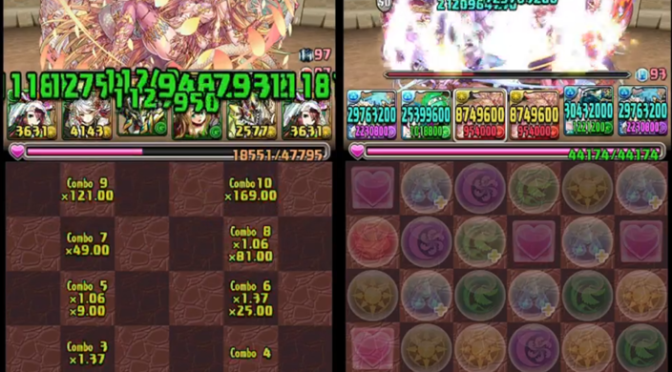
Awoken Kushinadahime is a purely skill based combo leader who is unable to gain benefits from skyfalls. In addition, her leader skill is directly tied to the number of combos she is able to form so she is not for the feint of heart. Maxes out at 169x for 10 combos. —
Umisachi & Yamasachi
The wonder twins were Fantastic’s main leader back in the day and I was thrilled when they finally got the buff they deserved. They are still a rainbow based leader, but has the potential to achieve 400x with 3 water combos alongside their three other elements. They are still a glass cannon, but are able to dish out spectacular damage with relatively few orbs. —
Conclusion
Both Kushinadahime and Umisachi & Yamasachi are fun to play leaders with unique twists on current leader skills. Neither are able to form top tier leaders, but provide a breath of fresh air amidst all the rows and heart cross leaders.
Khepri Descended is the newest dungeon to be released in Puzzle and Dragons and comes with the wonderful Snowglobe challenge component. In order to successfully clear the challenge, you will have to beat the dungeon in solo mode with no continues and have the Snowglobe as a sub on any difficulty. This can be a daunting task as you are essentially losing a sub slot. Thankfully, you are able to inherit a skill onto your Snowglobe as there are quite a few new mechanics you will need to overcome.
There will not be any indication you successfully cleared the challenge component and I do not know when you will have the additional Snowglobes distributed. It will probably happen a week or so after the challenge finishes.
Video clear
Dungeon overview
Khepri Descended imposes the unique restriction of 4 seconds to move orbs. This means all of your time extend awakenings, leader skills that add time, and time extension badge are all worthless. As such, players will have to be able to carefully plan their moves and be prepared for less combos as you are not able to casually match orbs. Continue reading Khepri Descended Snowglobe Challenge with Awoken Persephone→
Sarasvati has historically been an orb-hungry glass cannon leader who was capable of delivering spectacular amounts of damage. Unfortunately, this came at the cost of low damage control and difficulty stalling due to no HP/RCV multiplier. However, over the course of the last maintenance, she was buffed to an easier to activate 100x leader who can now use a wider variety of subs along with stronger awakenings. I decided to take her for a spin in Super Ultimate Dragon Rush – Annihilation to showcase how her new leader skill functions as well as playing through end game content. You can read more about Sarasvati in my team building guide HERE.
Video clear
The key to success is properly managing your skyfall buff as it will get you killed on floor 3 and causes Ilsix to become more problematic as you have to carefully chip him down to under 30%.
Damage output is of less concern as essentially every floor dies when you match a row plus two water combos for 100x. Thus, the priority becomes survival and active management along with adequate heart orb generation.
Team used
I chose to run B/L Hermes instead of Awoken due to the extra health provided along with not wanting to have the skyfall buff. I regularly interchange which Hermes I bring to a dungeon and will do a subsequent post soon explaining my thought process in more detail.
Conclusion
The leader skill changes made to Sarasvati greatly eases her activation requirements as you are no longer restricted to only 12+ water orbs for damage. Furthermore, by having the ability to sweep various floors with only 3 water combos opens up potential for a wider variety of subs along with being able to easily overcome combo shield mechanics. Hopefully this video was informative and helps highlight how to effectively use Sarasvati.
I made a quick tutorial on how a System team works and decided it would be best to have it as a stand alone article. I will most likely reference it in the future as a way to explain how haste is valuable in certain monster reviews.
How does a system work?
A system is a term given to a team that is able to utilize haste actives on multiple cards to repeatedly chain multiple actives together. This allows you to cycle your actives quickly as a turn of haste reduces the remaining cooldown of all over actives. Do note that haste will only help your team and not your partner’s subs. Thus, haste has diminishing returns in coop. The two most common systems rely on having cards with a 7 turn cooldown and a single turn of haste in varying amounts.
4 haste actives
The first team has 4 total cards (friend leader is included) that possess haste and a 7-turn cooldown. Your two other cards can be anything you like and will have their skills charged very quickly. In essence, you use one haste active every turn and would then be able to use your first active on your fifth turn again as the haste from the other three would have been able to recharge you. Thus, the cycle continues.
Turn 1: use haste #1
Turn 2: use haste #2
Turn 3: use haste #3
Turn 4: use haste #4
Turn 5: use haste #1
repeat
This system allows you to easily charge up your two other cards as their actives are not being used. This strategy is common on Xiang Mei , Sumire , Kaede , and Awoken Cao Cao with 4 Scarlet subs.
6 haste actives
A team consisting of 6 haste actives is not very practical, but is mostly worth mentioning to showcase how it functions. Essentially, you use 3 actives every turn and this will cause enough haste to loop back to using the original 3 by the third turn.
Turn 1: use haste #1, 2, and 3
Turn 2: use haste #4, 5, and 6
Turn 3: use haste #1, 2, and 3
repeat
This was mostly used by the Scarlet System and does not have too many applications currently. Mostly just something to keep in mind.
Conclusion
Systems a powerful way to cycle your actives and can transforms what appears to be a lackluster team/leader into a more formidable one.
Version 9.4.2 has been released and one of the wonderful additions was Descend Challenges/Quests. Completing these will allow you to access various rushes via multiplayer on a permanent basis. These can be cleared again for an additional stone along with having easy access to these lucrative dungeons. I decided to take my Sarasvati team for a spin in Special Descend Rush – Annihilation due to the easy access to delay cards, ability to override skyfalls, ability to avoid the final floor binds, and being able to deal spectacular damage with a single active.
Video clear
Team I used
I did not use any inherits and latents are largely irrelevant for Sarasvati in this setting. Everyone is max skill and +297.
One nice benefit of using Sarasvati is the lower team cost on herself and the non-GFE subs as they are able to level up significantly faster which can greatly aid in the later floors, especially Linthia. I also forgot how to dual-colour combo solve for some strange reason.
In all honesty, that run could have been significantly smoother and I am confident I could min-max it better to reduce the level of risk as there are no surprises as each floor is a fixed spawn (unlike Arena).
Conclusion
Special Descend Rush – Annihilation is an exciting, albeit challenging dungeon to clear. It is not feasible to run on a regular basis as the drop rate is depressingly low; however, some people may wish to repeatedly play for the massive rank experience it rewards upon completion.
I dearly hope I can hold all of these drops with the 80 additional box space 😉
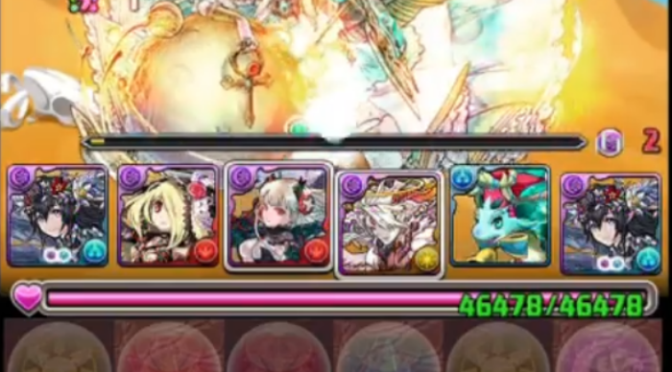
Machine Athena Descended was released alongside of the Skill Up rotation in the previous maintenance. As with any new content that is released, I am always eager to play as it provides new challenges and mechanics to overcome. These can require either careful planning or pretty puzzling to overcome. Most of the Annihilation tier content is catered around coop and it is possible to clear solo. However, I have neither the proper cards nor latents to do so and multiplayer also helps bridge the shortfall of my non-optimal teams. In addition, I do enjoy playing with myself through my Mantastic and Fantastic accounts.
Video clear
I was successful in clearing Machine Athena on my third attempt with the final two being done on stream. Due to the nature of streaming and my attempts to interact with my viewers along with my over zealousness to stall, it is quite long, but worth watching to learn about the new darkness mechanic along with how to deal with the later floors. —
Team line up
Myr is capable of clearing Machine Athena solo; however, it requires cards that I do not own (such as a delay on Mantastic) along with numerous skill delay resists to minimize the risk from all the preemptives in the dungeon. You also require a shielding sub to survive Athena’s <50% attack.
Mantastic’s Team
Card
Inherit
Latents
Comments
Sylvie may not combo with anyone, but her active is very powerful
Protects against skill delays
–
Recover bind helps remove binds from the team
Board changer and combos with Wedding Akechi .
Using Venus for superior stats
Best remaining light card. Can overwrite skyfall debuffs.
Gadius helps offer new utility and skill delay protection.
Can combo with other heart makers to produce damage

![[Videos] 37 Rolls in Player’s Choice Godfest – Winter 2016](https://mantasticpad.com/wp-content/uploads/2016/12/capture7.png?w=672&h=372&crop=1)


 on the account that only collects stones).
![[Videos] Fixed Team Challenge Descends](https://mantasticpad.com/wp-content/uploads/2016/11/acala-kill-f-horz.png?w=672&h=369&crop=1)

 DQXQ vs Hephaestus Descended


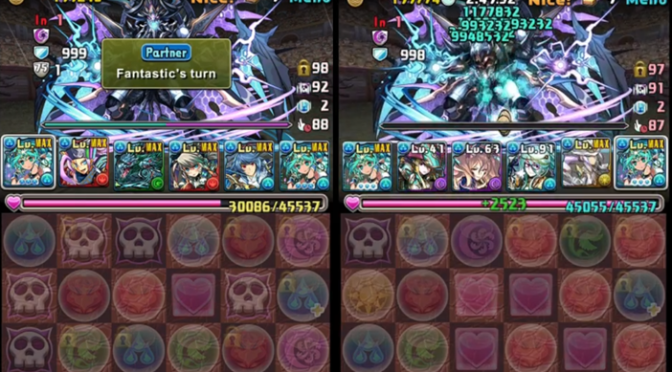


![[Video] Solo Arena 1 vs Tsubaki System](https://mantasticpad.com/wp-content/uploads/2016/11/tsubaki-damaga-f.png?w=672&h=372&crop=1)







![[Video] Special Descend Rush – Annihilation vs Sarasvati](https://mantasticpad.com/wp-content/uploads/2016/10/kill-shot.jpg?w=672&h=372&crop=1)


![[Video] Machine Athena Descended VS Myr](https://mantasticpad.com/wp-content/uploads/2016/10/m-athena-f.png?w=672&h=372&crop=1)


 Mantastic Puzzle and Dragons